Color is a basic property of cards in Magic: The Gathering, forming the core of the game's mana system and overall strategy.
General
There are five colors, sequenced white ( ), blue (
 ), black (
 ), red (
 ), and green (
 ); this arrangement is called the "color pie" or "color wheel". Devised by Magic creator Richard Garfield, the color system is one of the game's most fundamental and iconic elements. It gives the game diversity in its cards, effects, and play styles while preventing any one deck from having every tool in the game. Mark Rosewater considers the invention of the color pie to be part of the Golden Trifecta that made the game successful.[1]
Each color signifies an ideological faction, whose culture defines the flavor and gameplay of its cards, as well as its relations with the other colors. Each color has its means and motivation for doing battle in Magic, which ties into its strengths, weaknesses, and unique mechanics. Each color is situated in the color pie's order, colloquially referred to as "WUBRG", such that adjacent colors are ideological allies, while non-adjacent colors are enemies. There are five colors, such that each color has an equal number of allies and enemies, and five is the lowest number to achieve this permutation. However, the concept of there being five colors originated from previous games Richard Garfield designed, inspired by Lyndon Hardy's fantasy novel Master of the Five Magics.[2]
Head designer Mark Rosewater has written many articles about the color pie, both on its portrayal in-universe and its implications on the design and development of cards. There is a quotation from Mark Rosewater at the start of each color's section on this page that briefly describes that color's philosophical goal, "X", and means of achieving it, "Y", in the form of "X through Y".[3][4][5][6][7] He has also helped to establish a group called the Council of Colors that manages and maintains each of the color's mechanical identity.[8]
Note that colorless is by definition not a color and therefore lacks a well-defined philosophy and mechanical identity outside of factions designed around it, such as Eldrazi.[9]
Rules
From the glossary of the Comprehensive Rules (November 14, 2025—[[Teenage Mutant Ninja Turtles]])
- Color
- 1. A characteristic of an object. See rule 105, “Colors,” and rule 202, “Mana Cost and Color.”
- 2. An attribute mana may have. See rule 106, “Mana.”
From the Comprehensive Rules (November 14, 2025—[[Teenage Mutant Ninja Turtles]])
- 105. Colors
- 105.1. There are five colors in the Magic game: white, blue, black, red, and green.
- 105.2. An object can be one or more of the five colors, or it can be no color at all. An object is the color or colors of the mana symbols in its mana cost, regardless of the color of its frame. An object’s color or colors may also be defined by a color indicator or a characteristic-defining ability. See rule 202.2.
- 105.2a A monocolored object is exactly one of the five colors.
- 105.2b A multicolored object is two or more of the five colors.
- 105.2c A colorless object has no color.
- 105.3. Effects may change an object’s color or give a color to a colorless object. If an effect gives an object a new color, the new color replaces all previous colors the object had (unless the effect said the object became that color “in addition” to its other colors). Effects may also make a colored object become colorless.
- 105.4. If a player is asked to choose a color, they must choose one of the five colors. “Multicolored” is not a color. Neither is “colorless.”
- 105.5. If an effect refers to a color pair, it means exactly two of the five colors. There are ten color pairs: white and blue, white and black, blue and black, blue and red, black and red, black and green, red and green, red and white, green and white, and green and blue.
Representation and meaning
Each of the five colors represents a set of beliefs and principles, giving identity to Magic's characters and organizations. A color's philosophy explains how it sees the world, what objectives it hopes to realize, and what resources and tactics a color has at its disposal. This dictates which card types and abilities thematically fit within a color, allowing the game's flavor to connect with and even define its functionality.[10][11] The basic concepts related to each color are:
- White: Peace, law, structure, selflessness, equality[12]
- Blue: Knowledge, deceit, caution, deliberation, perfection[13]
- Black: Power, self-interest, death, sacrifice, uninhibitedness[14]
- Red: Freedom, emotion, action, impulse, destruction[15]
- Green: Nature, wildlife, connection, spirituality, tradition[16]
The colors form the cornerstone of Magic's mana system. Each color's way of thinking and acting is reflected via cards of that color having access to exclusive abilities and an affinity for certain aspects of play.[11][17][18] But these are balanced by natural vulnerabilities, in that a color may lack a given skill set or have trouble handling certain problems.[19][20] A player can offset these weaknesses by adding cards of another color, but this versatility comes at the expense of a consistent mana base.[20][21]
The color pie
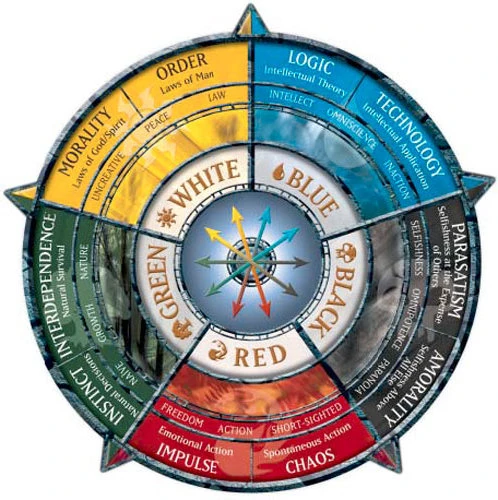
The color wheel
The color pie is portrayed as a circular pattern, clockwise in order: White, Blue, Black, Red, and Green. The back of each Magic card depicts the color wheel in the form of round colored gems. Adjacent colors in the wheel will be relatively similar in ideology and are known as allied colors (e.g. White's allies are Green and Blue).[22] In contrast, colors on opposite sides have radically conflicting views and are called enemy colors (e.g. White's enemies are Black and Red).[23]
While a set may occasionally feature enemy colors working together, colors are much more likely to work with their allies and against their enemies, more so if two allied colors join together against their shared enemy. Most blocks feature at least one cycle of hoser cards, typically with abilities that negatively affect one or both of a color's enemies.[19] For example, this cycle from Coldsnap later reprinted in 10th Edition: Luminesce, Flashfreeze, Deathmark, Cryoclasm, and Karplusan Strider. In contrast, very rarely will cards in a color have effects detrimental to an ally (e.g. Glissa's Courier).
Individualism within each color
The Magic books provides readers and players with greater insight and perspective on characters that represent a certain color or color combination at a personal level. When pulled apart from their kin, individuals can be shown to have traits in common with their color or guild, yet toned down to a smaller, more realistic scale.
For example, White as a group works toward peace, harmony, and unity. But for white as a lone soldier or citizens, these goals may be considered "too large" for their everyday lives. A White organization may believe in order and ethics, enforcing its beliefs through government, religion, and other large-scale institutions. However, White individuals may mirror this on a smaller scale, such as preferring their family to eat together at the dinner table or putting value in dining etiquette and proper manners. A White group can outcast a troublemaker, but individuals have little to no power to do so on their own. (Example: Gaze of Justice)
However, there are some guidelines and some rules for determining the identity of a character. First, there are five flexible traits, visible in characters of all colors but primarily represented in one color:
An organized character is not automatically White. A character that values organization, however, could be White. For reference, Black/Red has shown signs of organization in such cases as the mathematically designed destruction of Void and the efficiently-costed, targeted destruction of Terminate. Green/White has shown self-concern in the form of life gain (Heroes' Reunion), but that does not make Green/White selfish — that would be comparable to saying that a person is selfish for brushing their teeth. Instinct is unavoidable in all forms of non-artificial life, as even vampires must feed to sate their natural hunger. Wizards cannot learn on an empty stomach and even they are drawn to sexual partners — it is as nature wills, but that does not make them Green. It is the value of these traits that defines a character to a color, not the presence of them. That said, their presence should not be taken into heavy consideration.
Second, influence must be taken into account. If non-Black characters spend a great deal of time around Black characters, they will likely do some things that can be considered selfish or outright Black. This does not make the former group Black, as they may have been suffering under peer pressure, they may have lost or could be losing sight of morality, they may not be entirely aware of what they're doing, or they could perhaps be in the process of reconsidering their views and making a shift into or toward the color. Influences also come from bloodline, race, and occupation. If the character is a goblin in the Azorius Senate, they may be Blue/White, but will likely have a Red influence that will surface in their actions, words, responses, or thoughts. Typically, when an opposing influence surfaces, it serves only to dilute the character's other colors. For example, a Black/Red character with a White influence would be a much more toned-down version of a Black/Red character.
White
| “ | Peace through Structure
|
” |
Flavor
White puts value in the group, the community, and its civilization as a whole. White believes that suffering is a by-product of individuals not prioritizing the good of the group. White's ultimate goal is peace—a world where there is no unnecessary suffering; a world where life is as good as it can be for each individual; a world where everyone gets along and no one seeks to disturb the bonds of unity that White has worked so long to forge. To govern and protect its community, White makes use of and puts value in several broad concepts: morality (ethics, grace, truth), order (law, discipline, duty), uniformity (conformity, religion), and structure (government, planning, reason). More than every other color, White believes there is clear good and evil in the world and it is not too hard to distinguish them.
White is a color commonly associated with fairness and justice but, if left unchecked or if everyone is not working toward the same unified goal, White can become totalitarian, inflexible, and capable of sacrificing a small group for the sake of a larger one: everything necessary to preserve the laws, rules, and governance that White has created. White can convince people to work together in a way no other color can, but White must be ever vigilant that it does not become the very evil it hopes to eradicate from the world. Withal, White is stereotyped as being the "vanilla" or boring color, yet each White character or society embodies but one iteration of a panoply of conflicting political and economic views about the best way to pragmatically actualize White's ideals; the struggle within and between White characters and societies to uphold their interpretations of White's principles is what makes the color so interesting. What all White beings have in common is a belief in the power of social organization and the common good.
White has an ally in Green, which appreciates White's defense of life and tradition, and in Blue, which understands White's need for science and progress. However, Red's belief in anarchy and freedom puts it at odds with White's goal of supporting institutions, and White's altruism puts it directly at odds with Black's egoism.
Mechanics
- Damage prevention and life gain: White is a protector first; it has many cards that prevent damage to itself and/or its creatures ("healing"). In addition, White places great emphasis on the continuity of life, and endurance. It can restore life to a player, allowing that player to shake off the attacks of the opponent. In contrast, whereas Green life gain cards always have life gain as the main effect, there are White cards whose principal effect is not life gain but have that as a bonus, making White the best choice for keeping up a life total while fighting off the opponent. Note the keyword ability lifelink, primary in white. Examples: Healing Salve, Angel of Salvation, Ancestor's Chosen, Reverse Damage.
- Total protection: White is an inherently defensive color, and various protective mechanics supports defensive strategies. White's protective abilities range from universal protection abilities (colors or creature types), defensive combat abilities (flanking, exalted) and global creature boosting. Examples: Bathe in Light, Spare from Evil, Benalish Cavalry, Aven Squire, Glorious Anthem.
- Small creatures (Weenies): White uses the strength of cooperation and discipline to assemble a powerful army out of small creatures. Often these creatures have abilities (banding, first strike, vigilance) that make the whole group stronger. Examples: Benalish Hero, Knight of Meadowgrain, Steadfast Guard, Veteran Armorer.
- Rules-setting and "Taxing": White values order and law, and so it has ways of restricting the actions of players so that they do not do anything which White considers unnecessary or unfair. This can be an outright denial of privileges (rules) or imposition of some form of "cost" on a regular part of gameplay (taxing). Rules-setting on players is commonly symmetric, while taxation is asymmetric. Examples: Rule of Law, Humility, Windborn Muse, Ghostly Prison, Land Tax.
- Artifact and enchantment destruction: Although White is attached to both these types, it sees vice in their excess. White mana can purge what is false, to take away the vestments in which wickedness hides. Recently (with the rotation of Disenchant from Standard), White can destroy enchantments with much less effort (less mana) than for artifacts. Examples: Demystify, Tempest of Light, Dispeller's Capsule.
- Balance and uniformity: White has a sense of honor and fair play, which is seen in its use of mass destruction effects, and other 'equality' spells. "Mass destruction" spells reduce all players to possessing no more of any resource than that of the player with the least, and oftentimes, they set that quantity to zero. In addition, White believes in making the world uniform. Differences cause individuals to dissent and dislike one another. Differences only allow for unrest. In sameness, there is fairness, and the way to consider a person justly is clearer. Examples: Wrath of God, Balance, Mirror Entity.
- Peacemaking: White is a peacemaker, the first step of maintaining peace is to avoid combat. Peacemaking can be presented by prohibiting attacking/blocking, locking down activated abilities, and converting hostility to peace. Examples: Pacifism, Recumbent Bliss, Arrest, Condemn, Swords to Plowshares, Peacekeeper.
- Combat superiority: Ultimately, White wants to create peace. It has no interest in prolonging warfare and hates to kill even its enemies. As a result, White emphasizes the need for strong, effective methods to bring an engagement to a close - or at least bring the enemies' offensives, and resistance, to an end. In addition to spells that banish or utterly destroy attackers or blockers, White has creatures with abilities representing skills (e.g., "archery") that allow white's team to break up stalemates, protect each other from the enemy, and generally, facilitate the end of the hostilities. Examples: Hail of Arrows, Ballista Squad, Loxodon Mystic.
- Total defense: Above and beyond the degree to which White seeks options to expedite combat, it has every ability to stop attackers and other aggressors in their tracks. It will punish anything that causes - or even threatens to cause - pain. In this way, white magic sends a clear message, and it is that those who dare to inflict harm will soon meet their maker. Examples: Chastise, Neck Snap, Reciprocate, Retaliate.
Blue
| “ | Perfection through Knowledge
|
” |
Flavor
Blue is the color that wants perfection and looks on the world and sees opportunity to achieve that: figuring out what one could achieve with the right education, experience, and tools. For Blue, life is constant discovery as one keeps seeking to better oneself. This requires one to be open to possibilities, but also not be too hasty to act. Blue is methodical and exact and recognizes that there are many forces, even some that come from within, that lead an individual astray: better to think one's options out carefully and select correctly than to rush. Consequently Blue is, at times, excessively patient in the face of adversaries, but Blue regards this as a virtue rather than a vice.
Implicit in its world-view, blue believes in tabula rasa: every one of us is born a blank slate with the potential to become anything; one need only understand the how to make the change. Blue then reasons that if it is to make itself better, it must acquire the knowledge necessary to become capable of everything it could be capable of to discern the potential for any conscious action. Conceiving itself capable of changing anything if it both understands the change and knows how to achieve every capability it could have, Blue concludes that it must also control change itself. As such, Blue is the color most interested in technology and wants the latest and greatest version of whatever it is using. Moreover, Blue believes in logic, as it is the only tool that Blue regards as being truly objective: Blue has little use for sentimentality. Beyond its devotion to logic and direction of change, blue seeks to understand everything; for truly, comprehension can only improve one's effectiveness in any task. Since acquiring knowledge will inform every other decision, blue thusly forms its ultimate goal: omniscience, the knowledge of all.
Blue is allied with White, which shares its desire to promote civilization, and Black, which shares its value of individualistic self-improvement. Blue is opposed to Green, which it regards as savage and afraid of progress, and Red, which it regards as insane and destructive to itself and everything else.
Mechanics
- Card draw: Blue is the color of knowledge and research. As such, it is the best at expanding its mind, represented by unconditional drawing additional cards by minimum mana cost. This also comes about via card selection (i.e. the "looter" ability), which enables Blue to keep its ideas and plans relevant and up to date. Examples: Inspiration, Telling Time, Merfolk Looter.
- Counterspells: Blue is disposed to deny or reverse its opponents' actions, rather than take actions of its own. Blue's logic empowers it to prevent others from taking actions it deems foolish. The use of "countermagic" reflects Blue's understanding of magic itself: dismantling opposing spells at their fundamental level. Examples: Counterspell, Cancel, Mana Leak.
- Mimicry: Blue is the color of knowledge, where imitation of other cards can reflect its nature of desire to learn. Blue's mimicry effects are spell duplication and cloning. Examples: Twincast, Clone, Shape Stealer.
- "Return to hand" ("Bounce") effects: Blue is the color most adept at manipulating time. The use of bounce effects net crucial tempo for Blue, slowing its opponents long enough for a permanent solution to be found. It is an element of Blue's technological aspect: changing the environment, in precise ways, to its advantage, such as by removing an attacker or blocker or preserving one of its permanents. Examples: Boomerang, Evacuation.
- Tapping and untapping permanents: These effects come from Blue's tricky nature. The untapped status is necessary for certain actions, and for some of those, it is expended (the permanent becomes tapped). Due to this, Blue can slow or disrupt its opponent with tap effects, or untap its permanents for extra and perhaps unexpected uses. Examples: Dehydration, Stasis, Twitch, Puppeteer.
- Gain control ("Stealing") effects: Blue is a controlling color. It believes it knows best how to use others' resources. It is also very practical about combat, turning its knowledge of the mind toward controlling it. Examples: Persuasion, Take Possession, Annex.
- Trickery tactics: Blue's tricky nature also reflected by various tactical skills, including library destruction (milling), power reduction and power/toughness switching. Examples: Traumatize, Meishin, the Mind Cage, Merfolk Thaumaturgist.
- Combat trickery: Besides tactical skills, trickery attributes (unblockable) or combat abilities (flying, shroud, phasing) also mostly possess or grant by blue creatures and spells. Examples: Infiltrate, Jump, Spectral Cloak, Cloak of Invisibility.
- Reality changing: Blue is the color of changing things at will. Reality changing can be reflected by changing text, color, creature, and land type of the caster's choice. Examples: Mind Bend, Quickchange, Mistform Mask, Shimmering Mirage.
Black
| “ | Power through Opportunity
|
” |
Flavor
Black believes that the only measure of right and wrong should be whether or not an approach leads to success: amorality, rather than morality or immorality. Unnecessary suffering in Black's view is the result of a counterproductive approach, yet in different circumstances, the same approach could be the right one. Black knows the value of selfishness, so it is open to opportunities and strategies rejected by others as taboo or forbidden—undeath, torment, infection, betrayal. Black characters will ensure their well-being even at the expense of others; to Black, anything less only allows others to do the same. Thus, Black does everything possible to gain the only commodity that can secure it from weakness and ensure its ability to get whatever it needs or wants—power, even omnipotence. The only thing Black values more than its own life is its own will, as it sees the self as that which is most precious to all beings.
Black's selfishness and lack of ethical restraint can result in tragedy if misapplied, but Black is not inherently evil: egoism and pragmatic ambition are the source of much good in the world, especially when coupled with self-growth, and are the basis of individual rights. Unfortunately, the association of Black with villains and anti-heroes masks the other colors' potential for tremendous evil (a misconception that their villains and anti-heroes gleefully abuse), yet Black heroes often reach the highest pinnacles of self-actualization and personal growth out of all heroes: Black's virtues, including self-love, self-reliance, and willingness to face the ugly side of things, are all great seeds of heroic potential. Black has a very cynical worldview, and its core philosophy is that of self-determination and release from society's imposed limitations, so when things truly go awry, a Black hero capable of waking people up to reality is exactly what the world needs. This is because, beneath its wall of cynicism, Black is the color that most believe that can change fate against the most impossible odds—even if it must stand alone.
Black has an ally in Blue, as it appreciates its subtlety and use of cold logic. Black is also allied with Red, respecting its desire to do things on its terms. However, Black's disregard for other members of the group, spirituality/religion, and the sanctity of life oppose it to White and Green.[14] This is ironic in Green's case, as Black and Green agree that each alone is merely surviving and adapting to the world as it is: they just disagree upon what "the world as it is" is.
Mechanics
- Death and destruction: Black sees death not as a necessary evil, but as an effective tool. This gives it a variety of effects that kill creatures, many less expensive and with fewer conditions than those available to other colors. Also, black's mass removal is more calculated than average, often selectively destroying enemies while keeping its own most valuable creatures alive. Finally, with utter contempt for laws and morals in any form, Black can occasionally destroy enchantments. Examples: Murder, Royal Assassin, Reckless Spite, Plague Wind, Shatter the Oath.
- Culling the weak: Black has no qualms going after vulnerable targets, and its abilities can single out weaker or damaged enemies. Examples: Wretched Banquet, Final-Sting Faerie. It can also force opponents to sacrifice creatures, making them abandon their own weakest members. Once lesser creatures are dealt with, forced sacrifice can also eliminate threats that have abilities—such as hexproof or indestructible—that are resistant to black's direct removal. Examples: Call to the Grave, To the Slaughter.[17]
- Malaise: Black can use disease and suffering to debilitate creatures, potentially leaving them too weak to survive. Instead of inflicting damage to creatures, it will often give them -N/-N, reducing their power and toughness.[24] Mechanically, this lets black get around effects that would prevent or replace damage. Similarly, where red would deal damage to players, black's abilities typically cause direct loss of life. Examples: Grasp of Darkness, Death's Approach, Mutilate, Wicked Akuba.[18]
- Parasitism: Black method of gaining life is to leech it from others, using effects that drain health from creatures and players. Additionally, many of its creatures—particularly vampires—have lifelink, feeding off of their victims. Examples: Consume Spirit, Consuming Vapors, Gifted Aetherborn.[18]
- Cloak & dagger: Where others see underhanded tactics, black sees advantages in combat. It employs deathtouch, using poisons and necrotic effects to kill creatures that would have an edge in a direct assault. Black also uses darkness and apprehension to circumvent enemy creatures with evasion abilities such as flying, fear, and menace. Examples: Fetid Imp, Razortooth Rats, Graf Harvest.
- Necromancy: Black has no compassion for the dead and will raise an army of zombies and other undead to serve beyond the grave. Black can also return fallen creatures from the graveyard to its hand, and can even reanimate them directly to the battlefield. Examples: Nether Traitor, Disturbing Plot, Grim Return.
- Card advantage: Black's connections to the occult give it alternate means to pay for power, trading its own life for mana-efficient card draw. Examples: Read the Bones, Dark Confidant. Conversely, Black's ability to cause mental trauma in others lets it force players to discard cards. Examples: Hypnotic Specter, Gruesome Discovery.
- Faustian Bargain: Black will enter into agreements with demons and other beings like itself—power-hungry and self-serving. These give it access to some of Magic's best card search, or tutors. Examples: Sidisi, Undead Vizier; Demonic Consultation. These are strong but dangerous accomplices, however, with drawbacks that can destroy their summoner if not managed carefully. Examples: Lord of the Pit, Phyrexian Negator, Immortal Coil.[24]
Red
| “ | Freedom through Action
|
” |
Flavor
Red values freedom above all else. It wants to do what it wants when it wants, and to whom it wants, and nobody can tell it otherwise. In summary, Red thinks that all you have to do is listen to your heart and simply act accordingly, letting your emotions guide you. Red loves life much more than any other color and so it believes that all people must live it to the fullest. Red believes that life is an adventure and that it would be much more fun if everyone stopped caring about rules, laws, and personal appearances and just spent their time indulging their desires through experience. Red doesn't live their life questioning the choices they have made and lives at the moment; Red is spontaneous and embraces every adventure put before them. Red is often charismatic, even as its antics upturn the established order.
Red is the color of immediate action and immediate gratification. If it wants something, it will act on its impulses and take it, regardless of the consequences. On the other hand, Red may also seek to make amends: Red embraces relationships and knows passion and loyalty and camaraderie and lust. When Red bonds with another, it bonds strongly and fiercely. To outsiders, Red might seem a bit chaotic; that's only because others can't see what's in Red's heart. Red tendencies differ greatly: they may exist anywhere on the spectrum between loving empathy and vile hate, plus everything in between. In general, Red sees the concept of external order of any kind as pointlessly inhibiting, believing that only by embracing anarchy can everyone be free to enjoy life to the maximum with no regrets.
Red gets along well with Black, who agrees with Red's lack of adherence to social norms, and Green, who understands the value of listening to one's inner voice. However, Red does not get along with Blue, which sees Red's brand of creativity as extremely destructive rather than productive, nor with White, which regards Red's quest for ultimate freedom as a threat to civilization. Red, for its part, feels that Blue and White strip people of what makes them unique.
Mechanics
- Direct damage (Burn): Red favors direct action. It doesn't waste time looking for ways 'around' a problem—it blasts a path clean through. When the obstacle is a physical thing, Red employs this solution literally, throwing fire, rocks, or anything else at the problem until it goes away. Examples: Shock, Pyroclasm, Char, Fireball, Barbed Lightning.
- Artifact and land destruction: Red's use of destruction goes to a deep philosophical origin, although it is frequently explained as unthinking glee. Briefly put, order arises from tradition, which occurs when some things are constant or expected. Chaos is the counter to order because chaos is change - unsettling change. When everything is changing, people are free, because there is no tie to "the way things were." Since Red wants freedom, it uses chaos. Destruction is a force of chaos; it changes the world by removing something from it. Additionally, since Red is in every other respect a short-term thinker, the disruption effect of destroying your opponent's resources before they are used can be quite valuable. Examples: Shattering Spree, Manic Vandal, Volcanic Awakening.
- Aggressive creatures: Red is capable of mounting a quick offensive, hoping to blitz its opponents before they have a chance to react. Unlike White, Red's creatures are focused almost entirely on the attack; little to no thought is given to blocking or endurance. Red creatures can be fast, but often at the cost of consistency, long-term resources, or harm to the controller. Examples: Ball Lightning, Jackal Pup, Goblin Cohort.
- Impulsive Draw: At its core, Red wants to do whatever its heart's present desires and inspirations are right now, no matter how fleeting those feelings may be. This is no better exemplified by Red's ability to exile the top card(s) of their library to cast them, but only for a limited time - a time as short but vivacious as Red's perspective on life itself. Examples: Act on Impulse, Spark of Creativity, Jeska's Will.
- Martial superiority: Red is the color of action, red creatures possess several aggressive fighting abilities which shows speed (first strike, double strike), prowess (flanking), aggression (haste), overwhelming (trample), blind rage (rampage), and power enhancing (firebreathing). Examples: Anaba Bodyguard, Ridgetop Raptor, Agility, Fervor, Sunrise Sovereign, Ærathi Berserker, Fatal Frenzy.
- Gambits and short-term mana acceleration: Red wants to act on its desires without delay, whatever the cost. As such, its magic can give itself sudden, potent, but short-lived boosts of energy, or create high-risk-high-reward effects. This enables Red to do powerful things quickly and easily, though they carry the risk that, if the opponent recovers, Red's resources will "burn out." Examples: Fiery Gambit, Final Fortune, Seething Song, Desperate Ritual, Chaos Warp.
- Randomness: Red is the color of chaos; it can hurt itself and others randomly. Randomness spells can be reflected through coin flips and random card discard. Examples: Tide of War, Mana Clash, Barbarian Bully, Gamble.
- Trickery: Red is the color of pranksters; Red enjoys playing tricks on its enemies and changing the effects of their magic. Blue interferes with magic, too, but it specifically controls the magic for its long-term profit. Red is concerned more with taking control away from its enemies - forcing them to deal with the unexpected. Sometimes Red can dictate the new effect, sometimes it is random. Such trickery includes temporarily gaining control of permanents (Threaten effects), preventing creatures from blocking ("Panic"), and changing the targets of spells, though some cards in this category are truly unique. Examples: Threaten, Stun, Reroute, Confusion in the Ranks.
Green
| “ | Growth through Acceptance
|
” |
Flavor
Green loves the world just the way it is. This is because Green is convinced that nature has gotten everything right fundamentally and that it merely needs to be allowed the time and opportunity to develop its growth into further perfection. Green tries to coexist with the ecosystem instead of trying to change it, regulate it, norm it, or take advantage of it. As such, Green is the color of nature and interdependence. It believes that the truth of sentient beings is grounded in the natural order: a thing of beauty that has all the answers to life's problems as long as one listens closely enough to hear them. Green thinks that obeying our instincts is the best way to exist: that we, as part of the ecosystem, have a responsibility to protect it and to honor our natural selves. Wherever nature is lost, so are the available answers to us in the struggle to survive; so what affects one part of the ecosystem affects every part.
Green favors a simplistic way of living: being in harmony and communion with the natural world. This can lead to it being perceived as a pacifistic color, as it prefers to avoid extraneous conflict. Yet it is fierce when threatened and can be predatory and aggressive if its instincts dictate, and it may embrace change in the service of expanding nature and its cause. Green believes individuals are each born with a purpose: imprinted in their genes and interconnected with the physical and spiritual worlds. As everyone is born with unique roles, people's goal is to find what theirs are and do what they are destined to do. Each thread is woven into the web of life: we are not alone, but part of a complex system of inter-dependency. Green truly believes that every individual organism is part of this bigger picture—nature, the tapestry of life, fate, and destiny—but that individuals may get too caught up in the details to see it.
Red and White understand Green's desire to protect nature better than the other colors, being representative of its freedom and order respectively, so this forms the basis of their alliance with Green. On the other hand, Green sees Black's liberal use of death and undeath as a violation of the cycle of life and a rejection of Black's role in the grand scheme, causing them to be enemies. Finally, Green regards technology as both a frequent threat to nature and an often hubristic attempt to replace the natural order with an artificial one; Green therefore comes into conflict with Blue which seeks to actively reshape and improve the world utilizing technology.
Mechanics
- Powerful creatures: As the color of nature and growth, green can field mighty creatures with ease. Although other colors have access to cheap creatures or strong creatures, Green alone has access to efficiently costed and well-rounded creatures at any cost. Examples: Elvish Warrior, Leatherback Baloth, Verdant Force.
- Token creatures: Tying in with green's creature focus and emphasis on growth is its ability to generate large numbers of token creatures. In green, these effects are often repeatable and represent an ever-expanding community of creatures. Examples: Thallid, Centaur Glade.
- "Pump" effects: Green's philosophies of growth and strength both mean it can boost the power and toughness of its creatures, making them more effective in combat. These boosts can either be temporary, through instants and sorceries, or permanent through enchantments and +1/+1 counters. Green also has creatures that can provide a temporary boost to another creature or gain a temporary boost when blocking. Examples: Giant Growth, Thrive, Briarhorn, Giant Badger.
- Instinct attack: Green relies on instinct, which is reflected in the tactics of combat. Excess damage to creatures and their controllers results as trample and even extreme as super trample. Lure is a passive ability to force opposing creatures to block, making smaller creatures be killed by the larger creatures. Examples: Endless Wurm, Rhox, Lure, Elvish Bard, Hunt Down.
- Natural evasion: Green creates its way to achieve evasion to prevent damage from the other colors. It can be "uncounterable" and "untargetable" (reflected by shroud and ultimately hexproof) by spells or abilities. Unique "anti-flying" tactics include dealing damage/destroying creatures with flying, removal of flying ability, punishing the opponent for having flying creatures, and the keyword ability reach. Examples: Argothian Enchantress, Plated Slagwurm, Hurricane, Canopy Claws, Wing Storm, Giant Spider.
- Natural blessing: Green-aligned factions can gain benefits from nature. Regeneration is a protective ability for survival. On the other hand, Green has offensive abilities such as lethal damage from nature like deathtouch, "venom" ability, and using poison counters. Examples: Gorilla Chieftain, Acidic Slime, Venom, Thicket Basilisk, Marsh Viper
- Permanent mana acceleration: Green's focus on growth enables it to permanently expand its mana base, varying from creatures that produce mana, enchantments that generate additional mana, land tutors, and putting additional lands into play. Examples: Llanowar Elves, Overgrowth, Sylvan Ranger, Exploration.
- Mana fixing: Green's community aspect means it is the best color at creating other colors of mana, either through being able to search for other lands or through changing one color of mana into another. Examples: Birds of Paradise, Farseek, Orochi Leafcaller.
- Artifact and enchantment destruction: Green hates illusions and the artificial, seeing them as perversions of the natural world. Thus, green actively works to destroy such things. Examples: Naturalize, Viridian Shaman.
 Colorless
Flavor
Colorlessness is the absence of color, and thus, has no inherent philosophy, hence why there is no maxim by Mark Rosewater for this section. Most artifacts, being run on science and technology rather than magic (though exceptions on planes like Avishkar do exist), are colorless.[25] In terms of alliances artifacts can be considered neutral, though green generally dislikes artifacts as a concept, while blue is more than happy to work with them extensively. However, there are some colored artifacts, which have a stronger connection to their respective color.
Besides artifacts, the Eldrazi tribe is also colorless. This ancient race is native to the Blind Eternities and their nature is ceaseless hunger, so they travel between planes devouring the mana and life energy until the plane's destruction. Before the destruction of a plane, they first destroy its color leaving behind Wastes, sources of colorless mana.
Ugin is also colorless, tied with his ancientness that gives him a transcendence over the colors. Accordingly, he has developed colorless magic like concealment magic or his Ghostfire.
Mechanics
Although colorless mana sources exist, colorless is not a color. Colorless cards either lack colored mana symbols in their mana cost or have an effect like devoid. The presence of the colorless mana symbol in the cost is not required; most colorless cards have entirely generic mana costs. Because generic costs don't need a specific type of mana, colorless cards can be played in decks of any color.
Colorless cards can have mechanics usually reserved for a specific color, but typically at a higher mana value for a given effect. For instance, colorless equipment can grant otherwise color-exclusive effects to any deck, but with less mana efficiency than a colored aura. Artifacts can be considered a "Jack of all trades, master of none," though they too have unique strengths; in the case of equipment, it doesn't leave the battlefield with its attached creature like auras do.[26]
As another example, haste is primary in red. Red can get a 2/2 with haste for three mana in Raging Cougar, Goblin Chariot, or Suq'Ata Lancer, the latter of which also has flanking. It can even have a 2/2 haste for just 1 red mana with Goblin Guide. Meanwhile, Arcbound Hybrid, a 2/2 artifact creature with haste, costs  , albeit with the artifact-exclusive mechanic modular.
Artifacts are often indestructible, but there are a set of mechanics unique to them like modular, imprint, and sunburst. Many of these mechanics involve combining with other cards like equip, fortify, crew or living weapon.
The Eldrazi on the other hand have their very own tribal mechanics like annihilator, devoid, and ingest.
Face-down cards placed by morph and manifest are also colorless.
 Multicolored
Some cards are multicolored (sometimes called "gold" due to their card frame), meaning they require more than one type of mana to use. Although Invasion block, the first set prominently themed around multicolor, was a smashing success (as evidenced by a definite spike in tournament attendance), in Mark Rosewater's words, it wasn't a mechanic they explored much. The card pool was dominated by "Chinese menu" cards, meaning they took one ability from two colors, scrunched them together on one card, and saw what happened. (the adage of "one from column A, one from column B")
The "guild model" from Ravnica block has given way to a new era of understanding color combinations (especially two-color combinations). Mark Rosewater boldly campaigned to showcase all ten two-color combinations equally. Later the "small plane model" (shards) from Alara block and the "clan model" (wedges) from Tarkir block added a deeper understanding of the three-color combinations. The "triomes" from Ikoria gave new names to the wedge colors but the colors are not tied to factions or existing wedge identities.
Finally, Commander 2016 gave the first identities to the notoriously hard-to-design four-color combinations.
| Ravnica Guilds (Color Pairs) |
|---|
| Strixhaven Colleges (Enemy Colors) |
|---|
| Alara Shards (Arcs) |
|---|
| New Capenna Families (Arcs) |
|---|
| Tarkir Clans (Wedges) |
|---|
| Ikoria Triomes (Wedges) |
|---|
| Four-color Identities in Commander 2016 |
|---|
|
The last color combination is WUBRG () which combines aspects from each color, as exemplified by Unite the Coalition and Conflux.
Deviations
Changes over time
Throughout the game, the Magic development team has occasionally moved mechanics already established in one color to another. This is usually for balance reasons, particularly if a color has enough tools to negate its weaknesses, or has a disproportionate amount of design space. A major mechanical shift was made around 2003; at the time, blue and black had too many mechanics at the expense of the other colors.[27]
Change can also result from a re-examination of flavor; for instance, efficient artifact destruction was moved from white (Disenchant) to green (Naturalize) to better emphasize green's conflict with blue regarding technological progress.[27] Similar effects can be merged into a color to better highlight the mechanical distinctions between colors. Conversely, effects broad in scope can be split to prevent widely used mechanics from being tied to a single color.[28]
In terms of flavor black and red tended to be portrayed as evil in early lore while white, blue, and green were generally good, but not soon after nuances were introduced and protagonists and antagonists became represented in all colors.
Color bleed
While the color pie is the foundation of Magic, from time to time, R&D stretches what mechanical and creativity is allowed in each color. When cards in a certain color do something that the color doesn't normally do, it is called color bleed. When the bleeding goes too far it is called a color bend or in the worst case a color break. A bend pushes in a direction that falls within color philosophy but outside of normal mechanical implementation. A break undermines a weakness that is core to the color.[20][29][30][31]
Un-colors
The Unhinged set features additional colors. Water Gun Balloon Game can create a pink permanent, and Avatar of Me is the color of its caster's eyes. Because of this, when using abilities that produce mana of "any color", you may choose any color. However, there is no Unhinged (Basic) Land card that can produce mana of these colors and no cards that require these colors of mana in any form.
The Unstable set uses gold as the color of a dragon token produced by Sword of Dungeons & Dragons.
Sixth color
A more serious discussion of a new color took place during the design of Planar Chaos. The sixth color, purple, would have been in opposition to green, but the idea never made it past the concept stage.[32]
Even though colorless is not a color, the appearance of the colorless mana symbol () in Oath of the Gatewatch birthed the idea of colorless as the sixth Magic color. With the expansion Kaladesh, energy ( ) was introduced as a way to pay ability costs rather than traditional mana.
Notes and references
- ↑ Mark Rosewater (March 11, 2024). "Looking Back, Part 1". magicthegathering.com. Wizards of the Coast.
- ↑ Extra Life Ask Wizards - Richard Garfield (Video). Magic: The Gathering. YouTube (September 21, 2016).
- ↑ Mark Rosewater (June 16, 2023). "Drive to Work #1043: Green-White-Blue"
- ↑ Mark Rosewater (June 30, 2023). "Drive to Work #1048: White-Blue-Black"
- ↑ Mark Rosewater (July 14, 2023). "Drive to Work #1051: Blue-Black-Red"
- ↑ Mark Rosewater (July 28, 2023). "Drive to Work #1055: Black-Red-Green"
- ↑ Mark Rosewater (August 18, 2023). "Drive to Work #1062: Red-Green-White"
- ↑ Mark Rosewater (August 26, 2024). "The Council of Colors, Revisited". magicthegathering.com. Wizards of the Coast.
- ↑ Mark Rosewater (January 13, 2019). "Where would you put colorless mana on the color pie?". Blogatog. Tumblr.
- ↑ Mark Rosewater (August 18, 2003). "The Value of Pie". magicthegathering.com. Wizards of the Coast.
- ↑ a b Mark Rosewater (February 24, 2003). "Bursting with Flavor". magicthegathering.com. Wizards of the Coast.
- ↑ Mark Rosewater (July 13, 2015). "The Great White Way Revisited". magicthegathering.com. Wizards of the Coast.
- ↑ Mark Rosewater (July 20, 2015). "True Blue Revisited". magicthegathering.com. Wizards of the Coast.
- ↑ a b Mark Rosewater (July 27, 2015). "In the Black Revisited". magicthegathering.com. Wizards of the Coast.
- ↑ Mark Rosewater (August 3, 2015). "Seeing Red Revisited". magicthegathering.com. Wizards of the Coast.
- ↑ Mark Rosewater (August 10, 2015). "It's Not Easy Being Green Revisited". magicthegathering.com. Wizards of the Coast.
- ↑ a b Mark Rosewater (August 11, 2014). "Acts of Destruction". magicthegathering.com. Wizards of the Coast.
- ↑ a b c Mark Rosewater (November 15, 2010). "Feel the Burn". magicthegathering.com. Wizards of the Coast.
- ↑ a b Mark Rosewater (February 18, 2002). "Enemy Mine". magicthegathering.com. Wizards of the Coast.
- ↑ a b c Mark Rosewater (June 13, 2011). "The Bleed Story". magicthegathering.com. Wizards of the Coast.
- ↑ Reid Duke (July 6, 2015). "The Basics of Mana". magicthegathering.com. Wizards of the Coast.
- ↑ Mark Rosewater (March 20, 2017). "Thank You for Being a Friend". magicthegathering.com. Wizards of the Coast.
- ↑ Mark Rosewater (November 14, 2016). "Pie Fights". magicthegathering.com. Wizards of the Coast.
- ↑ a b Randy Buehler (February 6, 2004). "Defining Black". magicthegathering.com. Wizards of the Coast.
- ↑ Doug Beyer (March 23, 2011). "A World Sculpted from Metal". magicthegathering.com. Wizards of the Coast.
- ↑ Wizards of the Coast (September 1, 2003). "Ask Wizards - September, 2003". magicthegathering.com. Wizards of the Coast.
- ↑ a b Mark Rosewater (July 21, 2003). "Small Changes". magicthegathering.com. Wizards of the Coast.
- ↑ Mark Rosewater (July 8, 2013). "Working Your Core". magicthegathering.com. Wizards of the Coast.
- ↑ Mark Rosewater (April 6, 2015). "Bleeding Cool". magicthegathering.com. Wizards of the Coast.
- ↑ Mark Rosewater (March 1, 2017). "Could you define what makes something a color pie bend versus a break?". Blogatog. Tumblr.
- ↑ Mark Rosewater (January 10, 2022). "Even More Words From R&D". magicthegathering.com. Wizards of the Coast.
- ↑ Mark Rosewater (July 30, 2014). "What color were you thinking of adding in Planar Chaos?". Blogatog. Tumblr.
External links
General
- Mark Rosewater (October 11, 2021). "Let's Talk Color Pie". magicthegathering.com. Wizards of the Coast. (A collection of links)
- Mark Rosewater (August 18, 2003). "The Value of Pie". magicthegathering.com. Wizards of the Coast.
- Matt Cavotta (September 7, 2005). "The Magic Style Guide (Part 1)". magicthegathering.com. Wizards of the Coast.
- Monty Ashley (September 2, 2010). "The History of the Color Pie". magicthegathering.com. Wizards of the Coast.
Allied colors
- Mark Rosewater (March 20, 2017). "Thank You for Being a Friend". magicthegathering.com. Wizards of the Coast. Archived from the original on July 23, 2023.
Enemy colors
- Mark Rosewater (February 19, 2002). "Hate Is Enough". magicthegathering.com. Wizards of the Coast.
- Mark Rosewater (November 14, 2016). "Pie Fights". magicthegathering.com. Wizards of the Coast.
Artifacts
- Mark Rosewater (September 29, 2003). "Domo Arigato, Mr. Roboto". magicthegathering.com. Wizards of the Coast.
- Mark Rosewater (February 28, 2005). "Just the Artifacts, Ma'am". magicthegathering.com. Wizards of the Coast.
Downsides
- Mark Rosewater (December 2, 2019). "More Maro on Maro". magicthegathering.com. Wizards of the Coast.
Mechanical implementation
- Wizards of the Coast (September 1, 2003). "Ask Wizards - September, 2003". magicthegathering.com. Wizards of the Coast.
- Mark Rosewater (August 11, 2014). "Acts of Destruction". magicthegathering.com. Wizards of the Coast.
- Mark Rosewater (June 5, 2017). "Mechanical Color Pie 2017". magicthegathering.com. Wizards of the Coast.
- Mark Rosewater (October 18, 2021). "Mechanical Color Pie 2021 Changes". magicthegathering.com. Wizards of the Coast.
Color bleed
- Mark Rosewater (June 13, 2011). "The Bleed Story". magicthegathering.com. Wizards of the Coast.
- Mark Rosewater (April 6, 2015). "Bleeding Cool". magicthegathering.com. Wizards of the Coast.
Planar Chaos (Timeshifted cards)
- Mark Rosewater (October 23, 2006). "American Pie". magicthegathering.com. Wizards of the Coast.
- Mark Rosewater (January 8, 2007). "Chaos Theory". magicthegathering.com. Wizards of the Coast.
Color hosers
- Mark Rosewater (February 18, 2002). "Enemy Mine". magicthegathering.com. Wizards of the Coast.
- Erik Lauer (January 2, 2009). "The Role of Hate". magicthegathering.com. Wizards of the Coast.
Monocolored
White
- Mark Rosewater (February 3, 2003). "The Great White Way". magicthegathering.com. Wizards of the Coast.
- Mark Rosewater (October 6, 2008). "Peace, Love and Understanding". magicthegathering.com. Wizards of the Coast.
- Mark Rosewater (July 13, 2015). "The Great White Way Revisited". magicthegathering.com. Wizards of the Coast.
- Mark Rosewater (May 19, 2025). "My Words: White". magicthegathering.com. Wizards of the Coast.
Blue
- Mark Rosewater (August 11, 2003). "True Blue". magicthegathering.com. Wizards of the Coast.
- Mark Rosewater (March 21, 2005). "The Troubled One". magicthegathering.com. Wizards of the Coast.
- Mark Rosewater (November 17, 2008). "Striving for Perfection". magicthegathering.com. Wizards of the Coast. Archived from the original on June 21, 2023.
- Mark Rosewater (July 20, 2015). "True Blue Revisited". magicthegathering.com. Wizards of the Coast.
- Mark Rosewater (June 23, 2025). "My Words: Blue". magicthegathering.com. Wizards of the Coast.
Black
- Mark Rosewater (February 2, 2004). "In the Black". magicthegathering.com. Wizards of the Coast.
- Randy Buehler (February 6, 2004). "Defining Black". magicthegathering.com. Wizards of the Coast. Archived from the original on February 24, 2004.
- Mark Rosewater (October 20, 2008). "Looking Out For Number One". magicthegathering.com. Wizards of the Coast. Archived from the original on February 6, 2023.
- Mark Rosewater (July 27, 2015). "In the Black Revisited". magicthegathering.com. Wizards of the Coast.
- September 17, 2025. "Mark Rosewater". magicthegathering.com. Wizards of the Coast.
Red
- Mark Rosewater (July 19, 2004). "Seeing Red". magicthegathering.com. Wizards of the Coast.
- Mark Rosewater (December 1, 2008). "Following Your Heart". magicthegathering.com. Wizards of the Coast.
- Mark Rosewater (August 3, 2015). "Seeing Red Revisited". magicthegathering.com. Wizards of the Coast.
- Mark Rosewater (October 20 2025) "My Words: Red"
Green
- Mark Rosewater (October 21, 2002). "It's Not Easy Being Green". magicthegathering.com. Wizards of the Coast.
- Mark Rosewater (November 3, 2008). "Searching Within". magicthegathering.com. Wizards of the Coast.
- Mark Rosewater (August 10, 2015). "It's Not Easy Being Green Revisited". magicthegathering.com. Wizards of the Coast.
- Mark Rose water (December 1 2025) "My Words: Green"
Multicolor
General
- Mark Rosewater (July 16, 2018). "Colorful Replies". magicthegathering.com. Wizards of the Coast. Archived from the original on July 23, 2023.
- Mark Rosewater (July 29, 2019). "Return of Colorful Replies". magicthegathering.com. Wizards of the Coast. Archived from the original on July 23, 2023.
- Mark Rosewater (June 9, 2008). "IM Legend". magicthegathering.com. Wizards of the Coast. Archived from the original on July 23, 2023.
Allied
- Mark Rosewater (May 1, 2006). "Slow and Steady". magicthegathering.com. Wizards of the Coast.
- Mark Rosewater (October 29, 2012). "Designing for Azorius". magicthegathering.com. Wizards of the Coast.
- Mark Rosewater (November 7, 2005). "Pretty Sneaky Sis". magicthegathering.com. Wizards of the Coast.
- Mark Rosewater (March 18, 2013). "Designing for Dimir". magicthegathering.com. Wizards of the Coast.
- Mark Rosewater (August 14, 2006). "Hedonism With Attitude". magicthegathering.com. Wizards of the Coast.
- Mark Rosewater (December 10, 2012). "Designing for Rakdos". magicthegathering.com. Wizards of the Coast.
- Mark Rosewater (January 30, 2006). "Aaaargh!!!". magicthegathering.com. Wizards of the Coast.
- Mark Rosewater (March 4, 2013). "Designing for Gruul". magicthegathering.com. Wizards of the Coast.
- Mark Rosewater (October 3, 2005). "Group Think". magicthegathering.com. Wizards of the Coast.
- Mark Rosewater (October 1, 2012). "Designing for Selesnya". magicthegathering.com. Wizards of the Coast.
- Doug Beyer (June 11, 2008). "Allies in Conflict". magicthegathering.com. Wizards of the Coast. Archived from the original on August 4, 2022.
Enemy
- Mark Rosewater (March 27, 2006). "Playing By Their Own Rules". magicthegathering.com. Wizards of the Coast.
- Mark Rosewater (March 25, 2013). "Designing for Orzhov". magicthegathering.com. Wizards of the Coast.
- Mark Rosewater (February 27, 2006). "Creative Differences". magicthegathering.com. Wizards of the Coast.
- Mark Rosewater (November 12, 2012). "Designing for Izzet". magicthegathering.com. Wizards of the Coast.
- Mark Rosewater (October 24, 2005). "Life and Death". magicthegathering.com. Wizards of the Coast.
- Mark Rosewater (November 26, 2012). "Designing for Golgari". magicthegathering.com. Wizards of the Coast.
- Mark Rosewater (December 5, 2005). "Disorderly Conduct". magicthegathering.com. Wizards of the Coast.
- Mark Rosewater (February 4, 2013). "Designing for Boros". magicthegathering.com. Wizards of the Coast.
- Mark Rosewater (May 22, 2006). "Improving Upon Nature". magicthegathering.com. Wizards of the Coast.
- Mark Rosewater (February 18, 2013). "Designing for Simic". magicthegathering.com. Wizards of the Coast.
- Doug Beyer (August 6, 2008). "Enemies in Harmony... Sorta". magicthegathering.com. Wizards of the Coast. Archived from the original on June 28, 2022.
Wedges
- Mark Rosewater (September 29, 2014). "We Will Survive". magicthegathering.com. Wizards of the Coast.
- Mark Rosewater (November 3, 2014). "Smart Thinking". magicthegathering.com. Wizards of the Coast.
- Mark Rosewater (February 2, 2015). "Whatever it Takes". magicthegathering.com. Wizards of the Coast.
- Mark Rosewater (November 17, 2014). "Finishing First". magicthegathering.com. Wizards of the Coast.
- Mark Rosewater (February 23, 2015). "What Doesn't Kill You Makes You Stronger". magicthegathering.com. Wizards of the Coast.
Four Colors
- Ethan Fleischer (October 24, 2016). "Designing Commander (2016 Edition)". magicthegathering.com. Wizards of the Coast.
| ||||||||||||||||||||||||||||||||||||||

